.png?h=455&iar=0&w=1182&rev=d74e300da7ba4627bde32b9c768419b5)



Resource Article
Common Window Condensation Questions
Want to know how to stop window sweat? We explain what causes condensation, when it's okay and when it's not, and provide you with some simple tips on how you can prevent moisture build-up.
It's that time of year again—the time when people bring their houseplants indoors, close up their homes for the winter, and start running the furnace. And seemingly right alongside of those activities come The Questions: “Why is there water on my windows?” “My windows are wet on the inside…is there something wrong?”
We hear these types of questions a lot, especially from people who have installed brand new windows. Their old ones didn’t experience moisture…why are they seeing it with their new ones?
It may be a bit counterintuitive, but it’s actually not necessarily a bad sign to see that water—condensation—on the inside of a window. We’ll explain what causes condensation, and provide you with some simple tips on how you can prevent moisture build-up before it even happens.
Condensation appears when warm, moist air comes into contact with cooler surfaces, like your window glass on a cold winter’s day.
While condensation is most common during the winter, it can happen whenever the water vapor in warm air contacts a colder surface: think about your iced tea glass on a hot summer’s day. The glass is (refreshingly) chilly; the air is warm and humid. When the two meet, your beverage “sweats”.
So, the water you’re seeing isn’t unusual. Condensation will appear from time to time on even the best-performing windows—in fact, it’s often noticed more often on better windows, because of their energy efficiency.
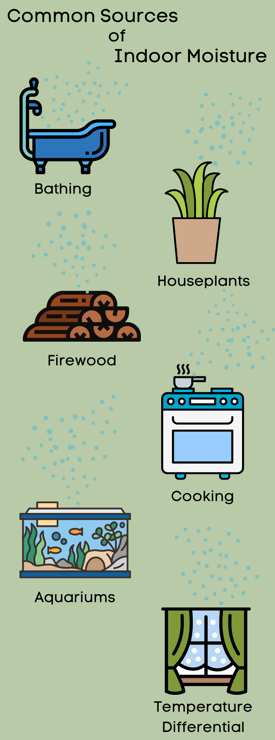
Everyday living generates a surprising amount of indoor moisture. If you cook three meals a day, you’re adding four or five pints of water into the air. Every shower someone in the household takes is another half-pint (more if you live with teenagers!). In short, every activity that uses water adds moisture.
“But,” you may think, “what about if I’m seeing condensation on windows that aren’t even near the kitchen or bathroom?”
Again, this is normal—because vapor pressure can force moisture through plaster, wood, brick, even cement, the condensation can occur far away from the actual moisture source.
Back to the question of "what does it mean?" Condensation doesn't necessarily mean there's a problem with your windows: in fact, the presence of condensation can actually be a sign that your windows have good, tight seals. The very things that make homes more energy efficient—windows and patio doors that reduce air leakage; weatherstripping; modern insulation; vapor barriers; and new construction techniques—also lock moisture inside your house, which increase the chance of condensation forming.
(What if the condensation is on the outside of the window? That’s the same as the dew on your lawn, and occurs mostly during the spring and fall when there are cooler nights and warmer days. And again—it’s typically a good indicator of energy-efficient windows.)
Condensation on the inside of your windows, then,is a by-product of humidity in the house. And while some humidity is good, and can make things more comfortable, tame static electricity in carpet, and prevent wood furniture/fixtures from shrinking and cracking, excessive humidity can cause problems in your home—mold or mildew may develop, water seeping into the insulation can freeze and thaw and cause damage to ceilings and walls, etc.
A good rule of thumb (especially if you live somewhere where the winters are typically very cold), is to maintain as high a level of humidity as you need for comfort, taking steps to lower it if you see signs of condensation on the windows. This can be as easy as turning off the humidifier (if you are running one). Other steps you can take to reduce indoor relative humidity include:
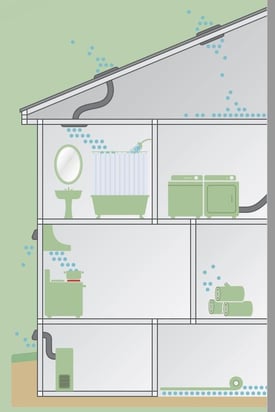
💧 Cover the earth/dirt floor in the crawlspace with a good vapor barrier.
💧 Avoid storing firewood in your home.
💧 Limit houseplants and aquariums. If you have many plants, try and keep them in a single sunny room, and do not overwater.
💧 Open blinds and drapes.
💧 Operate ceiling fans to improve air circulation.
💧 Raise the air temperature of the home (turning the heat up will decrease relative humidity).
💧 Vent all gas appliances, clothes dryers, and exhaust fans, to the outside.
💧 Ensure proper ventilation of attic and crawlspace.
💧 Run exhaust fans in the kitchen while cooking and in the bathroom while showering/bathing. Leave it running for 15-20 minutes after you are done (or until the mirror glass clears).
For more information on relative humidity, condensation, and your home, download “Understanding Condensation” from our resource library, or check out our video below for an illustrated guide to "stopping the sweat."
Thinking of replacing some of your older windows with new energy efficient ones? Contact us to schedule a free consultation.
Our Hassle-Free Process

Step 1
Design Consultation
Step 2
Measure and Manufacture

Step 3
Installation
Step 4